
A crawl space can be insulated two ways: through its walls and rim joist, which keeps it tempered and protects the plumbing, or through the floor above, which leaves it cold. Spray foam insulates, seals air and holds back vapour in a single application, at about R-6 per inch. For Rénoclimat 2026, you need 4 in.: at 3 in., the estimated grant drops to zero.
Updated November 11, 2026 · An expert measures at your home, then hands you a detailed, firm-price quote.
Why is the floor cold above a crawl space?
A crawl space is the low area, often dirt, between the ground and the floor of the house. Cold air moves through it freely: through the block or stone walls, through the rim joist, through the gaps around pipes. Homeowners feel it as an icy floor, drafts at floor level, rising moisture and, some winters, frozen pipes.
Insulate the walls or the floor?
Spray foam suits both. After the visit, we recommend one or the other based on height, access and what runs through the space.
- Insulate the walls and the rim joist. The crawl space becomes a tempered space: the plumbing that runs through it stays warm.
- Insulate the floor above. We spray between the joists, under the floor. The space stays cold: pipes and equipment in it need protecting.
Over a dirt floor, a membrane laid on the ground and sealed with spray foam around the perimeter cuts the contact between the soil and the house air, and the moisture rising from it.
Why spray foam in a crawl space?
Spray foam (also called spray polyurethane foam) insulates, stops air and holds back vapour in a single application, at about R-6 per inch. It bonds to concrete, masonry, stone and wood, works around pipes and wires, and leaves no joint for air to pass through. The full technique is in our spray foam guide for basements and crawl spaces.
What thickness do you need, and why 4 in.?
At about R-6 per inch, the R-23 that Rénoclimat requires is 4 in. The Airmétic Soya HP data sheet gives R-25.6 at 4 in. and R-18.5 at 3 in. (CAN/ULC-S770 test): at 3 in. the threshold is not reached and the estimated grant drops to zero. It is a calculation, not a promise: we confirm it with you before the work, and the thickness is written in the quote.
What Rénoclimat provides for a crawl space
Since October 1, 2026, Rénoclimat pays by the square foot, with no energy assessment, for work done by an RBQ-licensed contractor (us: RBQ 5839-3208-01) who signs the compliance certificate. The estimated grant is the lesser of the amount paid before taxes and the schedule's amount. LogisVert does not cover spray foam: here, Rénoclimat is the program.
| Work | R-value to add | Minimum area | Estimated grant |
|---|---|---|---|
| Crawl space walls, rim joist included | R-23 (4 in. of spray foam) | 300 sq. ft. | $3.50 per sq. ft. |
| Floor above the crawl space | R-23 (4 in. of spray foam) | 300 sq. ft. | $3.50 per sq. ft. |
For a house, the total grant for foundations and floors is capped at $2,500. The rim joist counts within the crawl space walls: on its own it almost never qualifies (see the rim joist page).
What loses the grant in a crawl space
- 3 in. instead of 4. R-18 instead of R-23: nothing.
- Under 300 sq. ft. A smaller space earns nothing, unless the walls and joist together reach the threshold.
- Work done before October 1, 2026, done yourself, or done by a contractor without the right RBQ licence.
Calculate the estimated grant for my crawl space
Rénoclimat's online application portal is not open yet (Québec.ca: under development, for this fall). Keep the itemized invoice, the signed compliance certificate and photos of the work: the application is due within 12 months of the end of the work.
A real job: the crawl space of a cottage in Mauricie
A four-season cottage in Mauricie, November 10, 2026
The block walls were bare, with glue left by old rigid insulation that had come loose, and the floor was cold. The crew removed the old insulation, decontaminated one section under the bathroom, then applied 4 in. of spray foam on 416 sq. ft. of walls and 104 linear feet of rim joist.
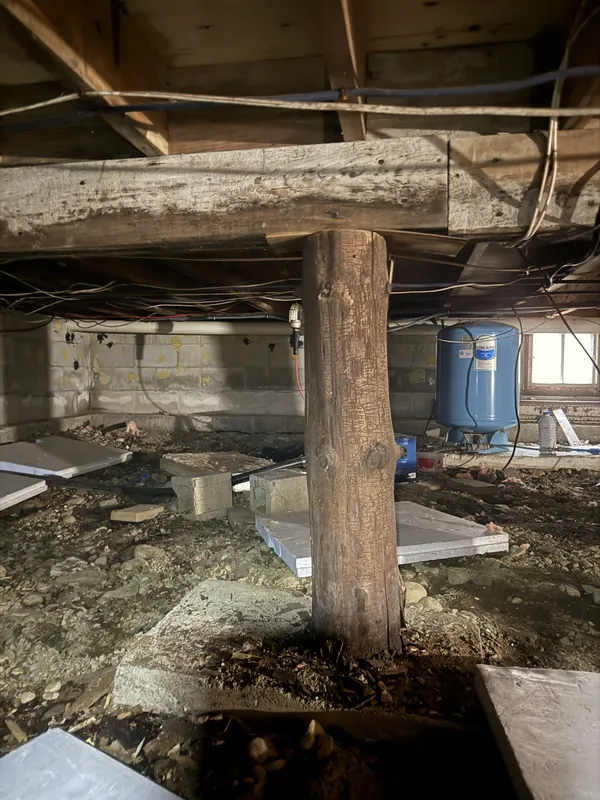
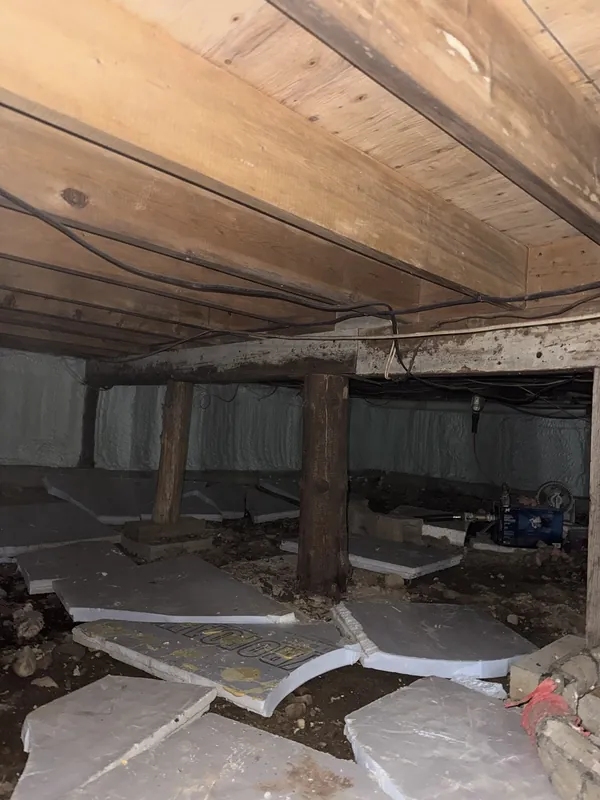
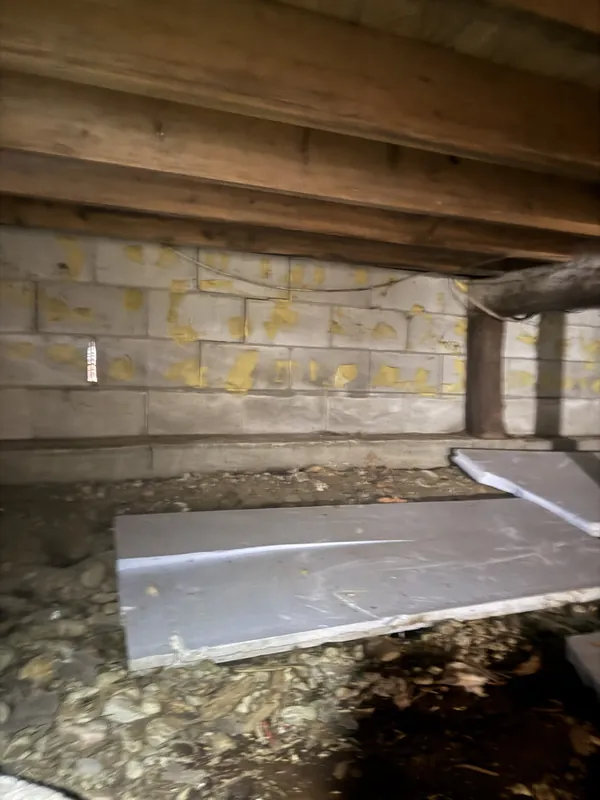
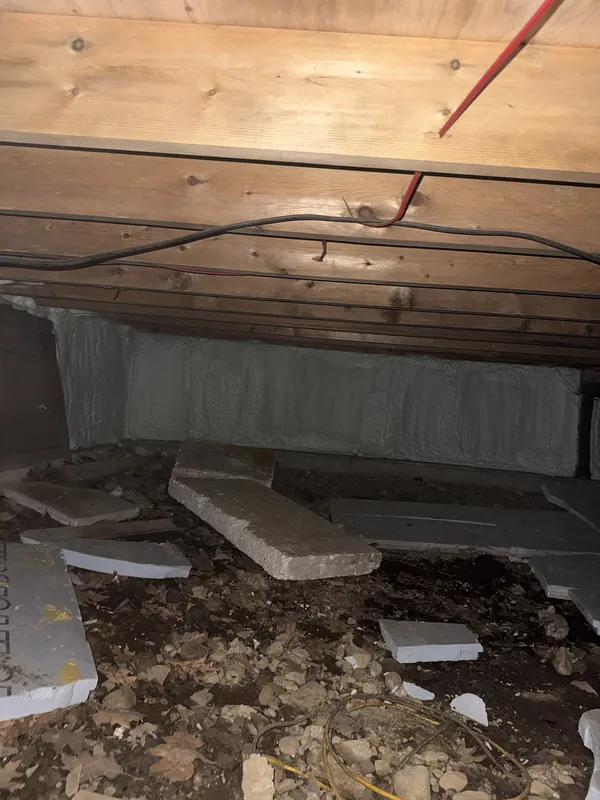
Under the 2026 schedule, the walls of a crawl space and their rim joist earn $3.50 per sq. ft. once R-23 is added. Here is the calculation:
- Invoice before taxes
- $3,171
- Area counted
- 416 sq. ft. of walls + 104 linear feet of joist (0.75 sq. ft. per foot) = 494 sq. ft.
- Schedule
- $3.50 per sq. ft., once R-23 is added
- Grant estimated under the schedule
- 494 sq. ft. × $3.50 = $1,729, rounded up to $1,730
- Share of the invoice
- a little over half (55%)
At 3 in., the same job would have earned nothing. The application will go through the portal when it opens, with the itemized invoice and our signed compliance certificate. The grant is estimated under the schedule: no amount has been paid yet.
The other approach: the floor, in the Montérégie, October 2026
For 616 sq. ft. of floor above a crawl space, at 5 in. of spray foam, the invoice was $3,427 before taxes. The grant estimated under the schedule is $2,160 (616 sq. ft. × $3.50 = $2,156, rounded up to the next $5), or 63% of the invoice.
How does the job go?
- 1
The visit and measurements
An expert measures at your home (visit within 24 to 48 hours) and hands you a detailed, firm-price quote on the spot.
- 2
Protecting the premises
We protect the surfaces around the area, remove old insulation if any, and lay the membrane over a dirt floor.
- 3
The application
Our certified applicators track the mix, the temperature and the thickness of each pass.
- 4
Checking and the report
We measure the thickness applied, then give you an end-of-work report with photos. For Rénoclimat, we sign the compliance certificate, and the invoice itemizes areas, thicknesses and R-values.
What should you know before the work?
- Plan to leave the house with the family and pets during the application, then for at least 25 hours (Airmétic Soya HP data sheet).
- Spray foam gets covered with a code-compliant thermal barrier: the quote states the covering and who installs it.
- Tell us about any combustion appliance near the area.
The rest is in the guide. On radon, spray foam reduces the entry points without solving it on its own (radon in the basement).
When is spray foam not the right answer?
- Water is coming into the crawl space. Spray foam insulates and stops air; it does not replace a repair. The water has to be fixed first.
- The wood is soaked. The manufacturer requires wood at 19% moisture or less when spraying: it has to dry first.
- A contaminant is present (vermiculite, asbestos, active mould). It comes out first, never under the foam.
What warranty covers the work?
The spray foam work is warranted for 2 years, in writing, and the product is covered by its manufacturer's warranty. The details are on our warranties page.
Keep reading
- Basement insulationFoundation walls and slab.
- Rim joist insulationAll the way around the house.
- The spray foam guide for basements and crawl spacesThe technique in detail.
- Spray foam insulationEvery place where it is the right choice.
- The grants guideRénoclimat and LogisVert.
Sources: Rénoclimat Participant's Guide 2026 (Québec.ca, in French, read on November 11, 2026) and the Airmétic Soya HP data sheet (Huntsman). The decision always belongs to the Ministry, on a complete application.